
Budgeting & Pricing

Custom Web App Cost in the UK

Calculate custom web application build costs in the UK. Understand pricing drivers, team shapes, MVP averages, and why compliance impacts your quote.

Obaid Tariq
Obaid Tariq
Updated 7 min read
Cover illustration for Custom Web App Cost in the UK
Table of Contents (7 sections)▼

Comparing Project Types: MVP vs Internal Tool vs Portal

Not all software costs the same, because not all software does the same job. An MVP exists to test a hypothesis fast — core functionality only, no fancy onboarding, no elaborate admin dashboards. In the UK, planning ranges for a solid MVP typically sit between £25,000 and £45,000. That's lean on purpose: prove traction before you sink capital into untested ideas.

Internal tools are a different animal. They replace spreadsheets and legacy processes for your own staff, so the money goes into dense functionality — role-based access, complex queries — not public-facing polish. Expect £40,000 for a single-department tool and well over £80,000 for a company-wide system. Customer portals cost the most: they expose your data to outsiders, so security has to be airtight, the design has to match consumer apps, and testing has to cover everything. Those typically start around £60,000 and can pass £120,000. We've seen founders budget portal money for an MVP and vice versa — know which one you're actually building before you ask for a number.
The Impact of Team Shape on the Final Quote

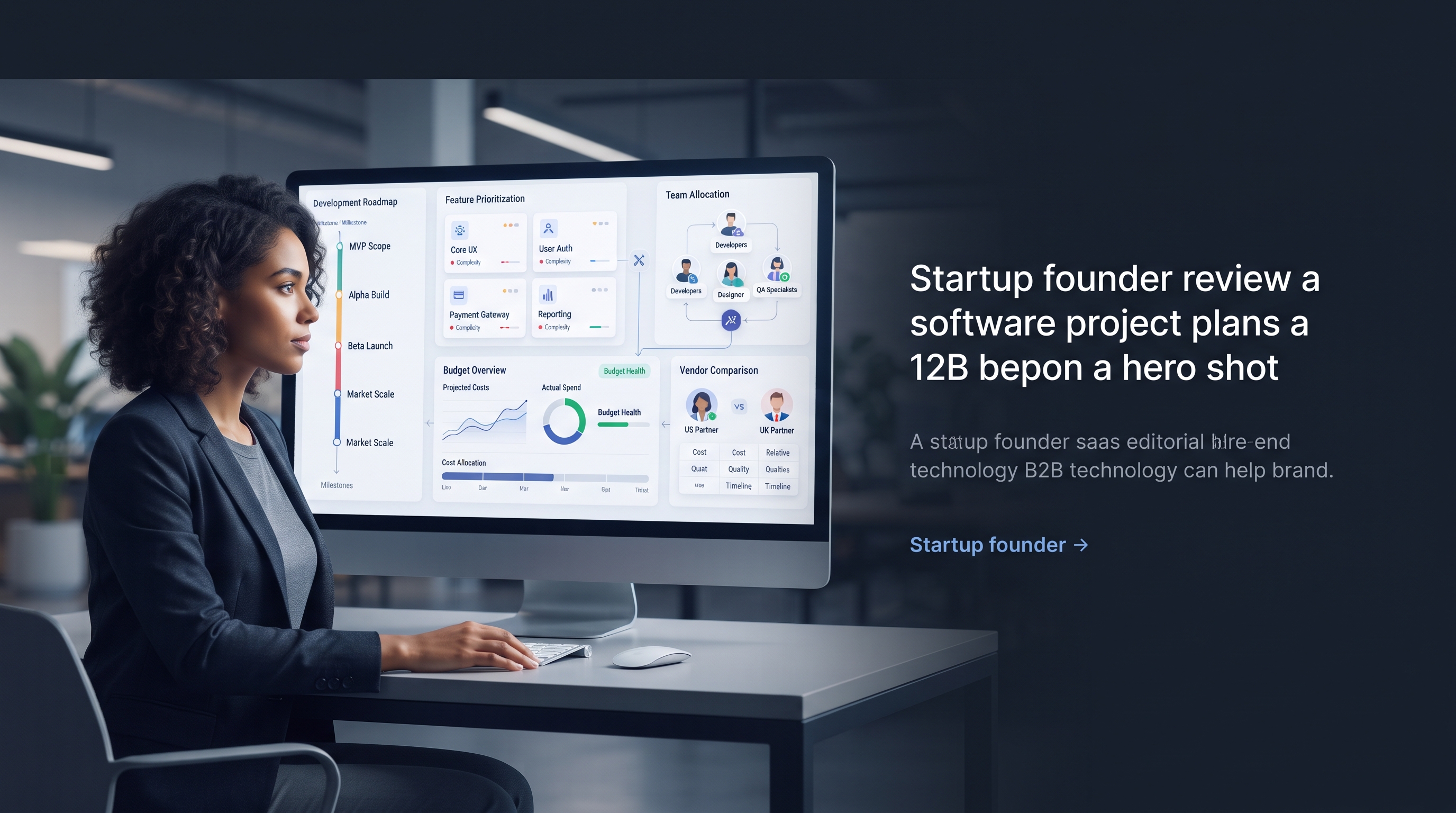
Who's on the team changes the quote as much as the scope does. A lean team — one senior full-stack developer plus a part-time project manager — burns slower but takes longer, and if that one developer gets sick, everything stops. That's key-person risk, and it's real.

A full team runs in parallel: a product manager, a UI/UX designer, a frontend specialist, a backend architect, and a QA engineer. It costs more per day, but the backend, frontend, and testing all move at once — so you reach market faster with software that's actually tested. The other variable is where the team sits. Pure onshore UK teams charge premium day rates and work your hours. Hybrid models — UK-based senior architects designing the system, nearshore developers building it — usually land in the middle on cost while keeping quality control tight. Our own model is remote-first from Islamabad with UK overlap hours, which is how our MVPs land at $25,000–$65,000 over 8–12 weeks instead of UK onshore rates. Same senior-led structure, different cost base. Be honest with yourself about which trade-off you're making.

How UK Compliance (GDPR and Accessibility) Changes Scope

Compliance is the line item founders forget, and it's not optional. If your system touches UK or European citizens, GDPR isn't a legal disclaimer you paste on at the end — it's engineering. The "right to be forgotten" means your backend has to trace and delete a person's data across every table it touched. Consent has to be logged, with proof of when someone agreed to tracking. Data at rest and in transit has to be encrypted. All of that is real backend hours, and it pushes scope well past a basic database.

Accessibility is the same story. WCAG 2.1 AA is mandatory for public sector work and increasingly expected in private systems too. It means semantic HTML screen readers can actually navigate, proper contrast ratios, keyboard-only flows, and correct aria-labels on every interactive element. You can't bolt that on with a third-party overlay after launch — we've seen teams try, and it fails proper audits every time. Scope it from the first sprint or pay for it twice.

What is Typically Excluded From a Build Quote?

The most common budgeting mistake we see: assuming the build quote covers the lifetime of the software. It doesn't. Four things are almost always excluded, and you need to budget for all of them.

First, hosting and infrastructure — AWS, Google Cloud, or Vercel — billed to you monthly based on usage. Second, third-party licences: mapping APIs, transactional email, video hosting. The agency connects them; you pay the vendor directly. Third, DevOps and maintenance after launch: security patches, API deprecations, browser changes. That needs a separate agreement, not a hope. And fourth, new features after launch — that's a new scope and a new budget, full stop. If a quote looks suspiciously cheap, check which of these four were quietly left out.

Essential Questions a Founder Should Ask

Before you sign anything, ask one question that tells you almost everything: "Show me your automated testing and deployment pipeline." A mature agency will happily walk you through CI/CD — how broken code gets stopped before it reaches a live server. If they can't explain unit testing or they're still deploying by manual FTP, walk away.

Then ask about IP. The right answer: on final payment, you own the entire repository, including commit history, with no lock-in clauses tying you to their frameworks. That's our rule too — the code lives in your GitHub from day one, not ours. Finally, ask how they handle technical debt. A good partner will tell you openly which shortcuts were taken to hit the MVP deadline and exactly what needs refactoring as you scale. Transparency about future problems is the sign of a team that plans to be around for them. If you want to test us on any of this, reach out to our team — we'll answer directly.

Website Quotes vs Application Engineering

Founders get sticker shock comparing a marketing website quote with a custom application estimate, and it's an unfair comparison. A UK small-business website costs a few thousand pounds. A custom application is a different product entirely — one displays static text, the other securely processes live database logic for your business.

On pricing models: fixed price protects you with a defined scope, day rate gives you flexibility when the roadmap is still moving. And support after launch doesn't have to be a huge open-ended retainer — a dedicated hour pack covers patching and dependency updates predictably. The point isn't which model you pick. It's that you pick one deliberately, with the exclusions written down, instead of discovering them in month three.

Frequently Asked Questions

What is the average timeline for an MVP build?

For a standard operational MVP, the typical timeline ranges from 12 to 16 weeks, covering architecture design, development sprints, and final QA verification.

Are server costs included in the initial quote?

No. Monthly hosting, database provisioning, and third-party API usage are operational costs billed directly to your business accounts — not part of the build price.

Do I own the intellectual property?

Yes. On settlement of the final invoice, full ownership of the source code and repository transfers to you. With us, the code sits in your GitHub from day one, so there's nothing to hand over at the end.

Why does accessibility compliance increase the budget?

Meeting WCAG means specialised frontend work: screen-reader navigation, keyboard-only flows, and precise contrast testing. It's real engineering time in the UI phase, not a checkbox you tick at the end.

Scope Your Budget

Get a technically accurate estimate based on your exact feature requirements.

Discuss Pricing
Obaid Tariq

Written by

Obaid Tariq

Founder & Lead Engineer at AI Dev Planner

Technical Practice:Next.js App Router, TypeScript, Multi-Tenant PostgreSQL (Row-Level Security), Supabase, and Deterministic Applied AI Integration. Direct founder-led engineering without sales reps or outsourced development.

Published: Updated:

More blogs

View more

Get the latest insights

Practical ideas for building better products, delivered directly to your inbox.

Case studies

Proven Implementations

Inspect related architectures, engineering metrics, and example systems for these capabilities.

View Full Portfolio
FinTech & Capital MarketsIllustrative Example — Composite Scenario
2024 · Custom Software Development

Migrating Core Infrastructure for a Global Financial Services Firm: Cloud-Native Microservices Architecture

Composite example: trading & asset-management firm (UK/North America)
London, UK & New York, USA
Business problem

Aging on-premise monolith suffered severe database lock contention and multi-second batch reconciliation drift during peak volatility, risking trader execution SLAs and regulatory audit compliance.

Executed deliverables

Complete redesign and deployment of the transactional backbone, asynchronous event streaming pipeline, and real-time execution cockpit.

Core technologies
AWS (ECS/Fargate)Apache Kafka (Amazon MSK)Next.jsNode.js+3
Example highlights (illustrative composite, design targets)
  • Zero Downtime Phased Strangler Cutover
  • Sub-20ms Real-Time WebSocket Feeds
  • 100% Immutable Kafka Audit Event Log
Healthcare & Clinical OperationsIllustrative Example — Composite Scenario
Illustrative · Customer Portal Development

Patient Intake Portal & EHR Integration (Illustrative Example)

A multi-clinic outpatient network (illustrative scenario)
United States (illustrative scenario)
Business problem

In this illustrative scenario, manual front-desk intake slows check-in, invites transcription errors, and delays insurance verification across a multi-clinic outpatient network.

Executed deliverables

The plan covers a responsive, mobile-friendly pre-registration web app, a clinical verification dashboard, and HL7/FHIR integration adapters.

Core technologies
ReactNode.jsGoogle Cloud KMSGoogle Cloud Vision OCR+2
Example highlights (illustrative composite, design targets)
  • Encrypted PHI Field-level Cloud KMS encryption (design target)
  • 100% Clinician Review Every extracted field verified before EHR write (design target)
  • Zero PHI Leakage Design target, not a measured result